
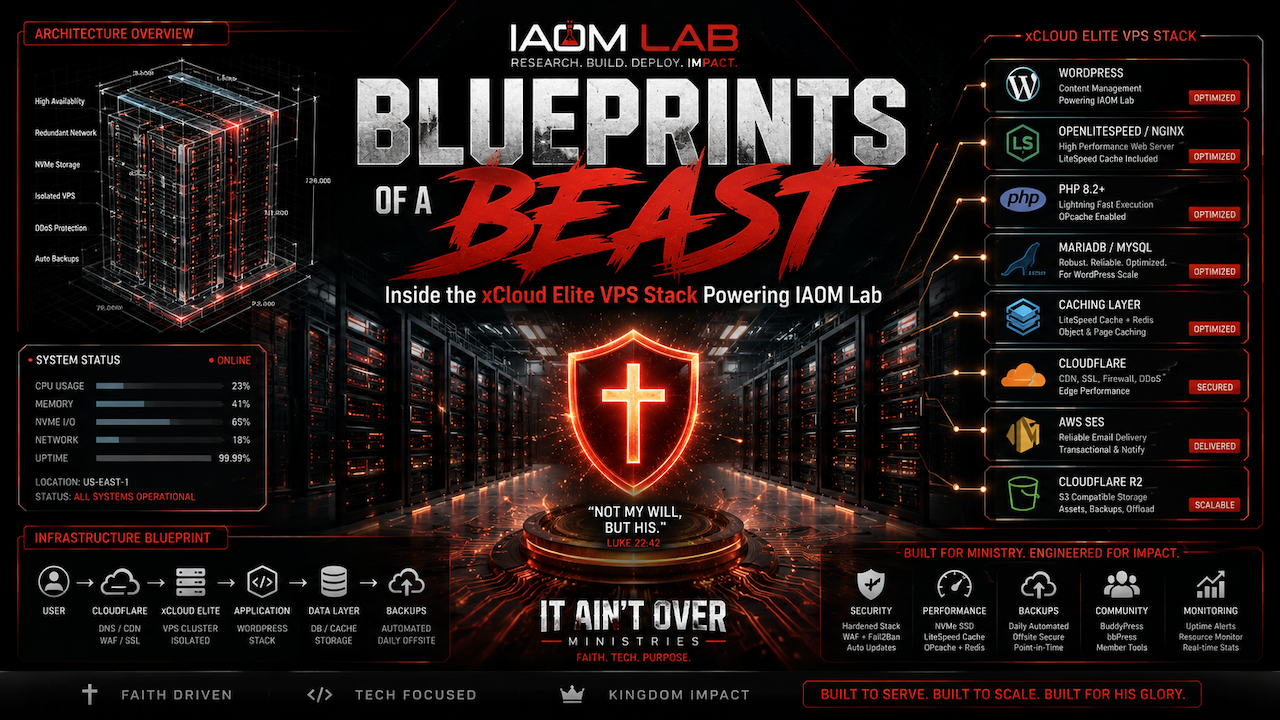

Inside the xCloud Elite VPS Stack Powering IAOM Lab
If you’ve ever wondered what’s actually running under the hood of a modern, production-grade WordPress environment, pull up a chair. This isn’t a shared hosting setup with a cPanel dashboard and crossed fingers. IAOM Lab runs on a fully managed VPS through xCloud’s Elite plan — and every layer of that stack was chosen intentionally, configured carefully, and stress-tested here before it ever touches a live Ministry site.
The Foundation: xCloud Elite VPS
xCloud’s Elite plan gives us full server management without the overhead of babysitting raw infrastructure. We get provisioned, managed VPS hosting with direct access to server-level controls, automated deployment pipelines, server monitoring, and a clean management layer that sits between us and the metal. It handles the heavy lifting of server provisioning, security hardening, and environment configuration — so our focus stays on what’s running inside the server, not the server itself.
The Web Server Layer: LiteSpeed + PHP-FPM
At the core of the stack is the super high powered, blazingly fast LiteSpeed, running as our web server and reverse proxy. LiteSpeed handles incoming HTTP/HTTPS requests with exceptional efficiency, and above industry standard speed, particularly under concurrent load — which matters when you’re testing Community platforms, form submissions, and CRM automations simultaneously. Paired with PHP-FPM (FastCGI Process Manager), we get a highly optimized PHP execution environment that manages worker processes dynamically, keeping response times tight even when the plugin stack is heavy.
The Database: MariaDB
MariaDB handles all persistent data storage. It’s a drop-in MySQL replacement with better performance characteristics, active open-source development, and improved query optimization. When we’re testing plugins like FluentCRM, FluentForms, and FluentCommunity Pro — all of which are database-intensive — having a properly tuned MariaDB instance means we can identify performance bottlenecks that would only surface under real-world load.
The Caching Layers: Redis + OPcache + Cloudflare Edge
Three caching layers work in tandem here. OPcache stores precompiled PHP bytecode in memory, eliminating the overhead of parsing and compiling PHP scripts on every request — a significant performance gain for WordPress. Redis operates as our persistent object cache, storing database query results and computed values so WordPress isn’t hitting MariaDB for the same data repeatedly. Cloudflare Edge Cache is a Content Delivery Network (CDN) feature that stores copies of our website’s static and dynamic assets across Cloudflare’s globally distributed data centers. When a visitor accesses our sites, Cloudflare serves the content from the server closest to them, drastically improving load times and reducing the strain on our origin server. Together, these three layers can be the difference between a sluggish website and a snappy one. Testing with all three active lets us simulate real production conditions accurately.
The Cloud Infrastructure: Cloudflare + Cloudflare R2 + AWS SES
Three cloud-layer services complete the infrastructure picture. Cloudflare sits at the DNS (Domain Name System) and edge layer — handling CDN delivery, DDoS mitigation, SSL termination, and firewall rules before traffic even reaches the origin server. Cloudflare R2 provides S3-compatible object storage for media offloading, letting us test file delivery pipelines, presigned URLs, and storage integrations without egress fees. AWS SES, wired through FluentSMTP, handles all transactional email delivery — giving us a very professional, high-deliverability, production-grade email infrastructure that we can validate thoroughly before connecting it to live Ministry communications.
The WordPress Layer
On top of all of this runs WordPress 7.0, paired with Blocksy Pro for theme management and Stackable Pro for advanced Gutenberg block layouts. The Fluent ecosystem — FluentCommunity Pro, FluentCRM, FluentForms, FluentSupport, FluentAuth, FluentSMTP, and FCAddons — handles everything from community features and contact management to form processing, support ticketing, authentication flows, and email routing. Wombal Forum and Asgaros Forum round out the Community infrastructure testing, and Meow Database Cleaner keeps the environment from accumulating the kind of table bloat that silently degrades performance over time.
Every piece of this stack serves a purpose. Nothing was installed without intention, and nothing stays if it can’t justify its presence under high-stress testing conditions. That’s the standard IAOM Lab holds every tool to before it ever gets near a live production Ministry platform.
Blogs
or explore Blogs