
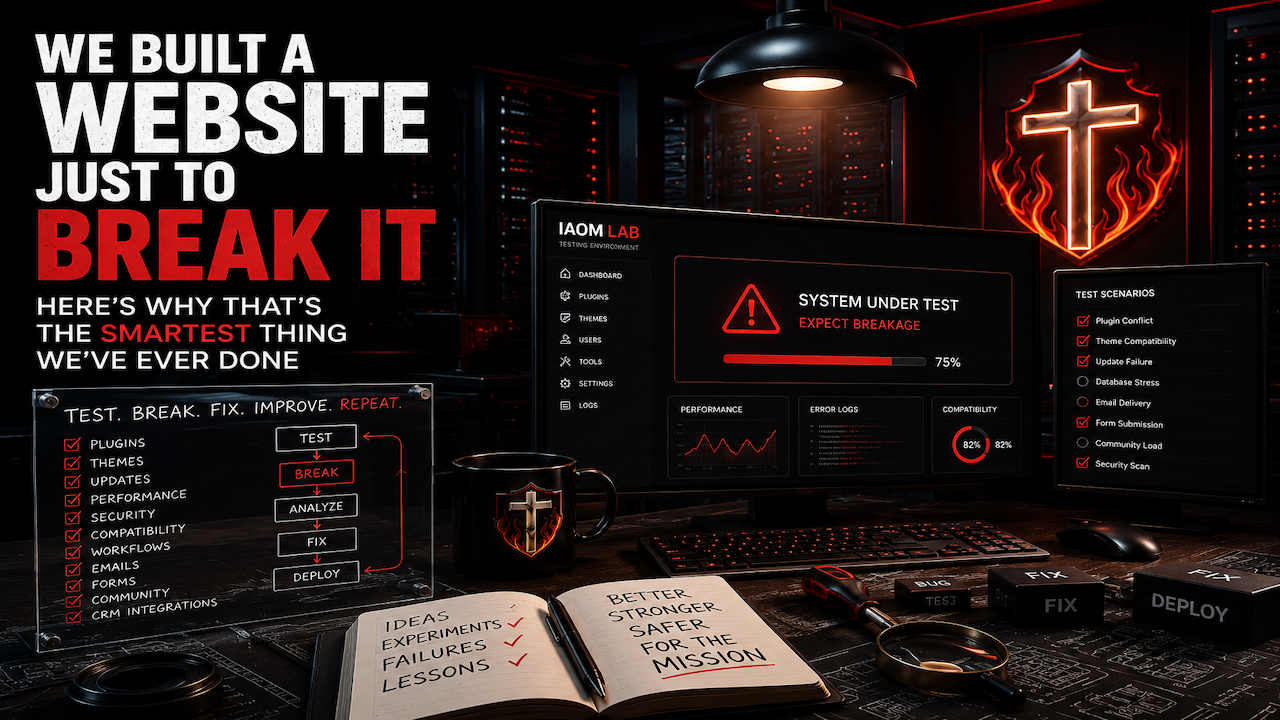
Here’s Why That’s the Smartest Thing We’ve Ever Done
Sometime in the not-so-distant past, a WordPress plugin update broke a live Ministry website. Not catastrophically — nothing exploded, no data was lost — but it broke enough to cause disruption, create confusion, and require emergency intervention on a platform that real people were actively using. It wasn’t the first time something like that had happened. And it absolutely would not be the last — unless something changed.
That something was the IAOM Lab.
The Problem With “Update and Pray”
If you manage WordPress sites long enough, you develop a muscle memory reflex around plugin updates. Something new drops, you click update, and you either breathe a sigh of relief when nothing breaks or spend the next two hours figuring out what went wrong. That workflow — update and pray — is fine when you’re running a personal blog. It is not fine when you’re running Dynamic Community platforms, CRM systems, email automation pipelines, and membership portals for a Ministry whose digital presence directly serves real people globally.
The more plugins you run, the more integration points exist, and the more places a single update can ripple into unexpected conflicts. FluentCRM and FluentCommunity Pro share data. FluentForms feeds into FluentCRM. FluentAuth sits between the user and all of it. A version bump in any one of these or other plugins in the tech stack can introduce a regression that breaks a workflow three layers deep — and you won’t find it until a user hits it in the live production site.
The Daily Workflow Inside IAOM Lab
IAOM Lab changed how we operate at a fundamental level. Every morning, before anything touches a live site, we run updates here first. Plugin updates, theme updates, WordPress core updates — they all land in this environment before they go anywhere else. We trigger the workflows, test the forms, verify authentication flows, poke the forum integrations, submit test tickets through FluentSupport, and check that FluentSMTP is still routing cleanly through AWS SES. We run the whole stack through its paces religiously.
When something breaks — and things do break — we document it, investigate it, and figure out whether it’s a true incompatibility, a configuration issue, or a bug that needs to be reported upstream. Sometimes it’s a plugin conflict that only surfaces with our specific combination of tools. Sometimes it’s a caching issue. Sometimes it’s a database query that starts behaving differently after an update. Regardless of what it is, we find it here, not in production.
It’s More Than a Testing Environment — It’s a Learning Environment
IAOM Lab has evolved into something beyond a simple staging site. It’s where we learn. New tools get installed and evaluated here. New layouts get prototyped. New community features get stress-tested before we commit to them on a live platform. We evaluate multiple forum solutions side by side — Wombal Forum and Asgaros Forum running simultaneously — so we can make informed, evidence-based decisions about which one serves our Community architecture best.
That kind of deliberate, structured evaluation isn’t possible on a live site. You can’t run competing solutions in parallel on a production platform without disrupting your audience. Here, we can.
The Ministry Case for a Staging Environment
There’s a stewardship argument here that goes beyond technical best practices. The people who depend on the digital platforms operated by It Ain’t Over Ministries deserve a reliable, stable, consistent experience. They’re not there to be beta testers. They’re there because the Ministry serves a real need in their lives. Every hour spent fixing a broken production site is an hour the platform isn’t serving its purpose.
The IAOM Lab exists so that the mission never goes offline because of something that could have been caught in a controlled environment first. That’s not over-engineering. That’s faithfulness to our Calling, Purpose, and the people we serve.
Blogs
or explore Blogs